Introduction
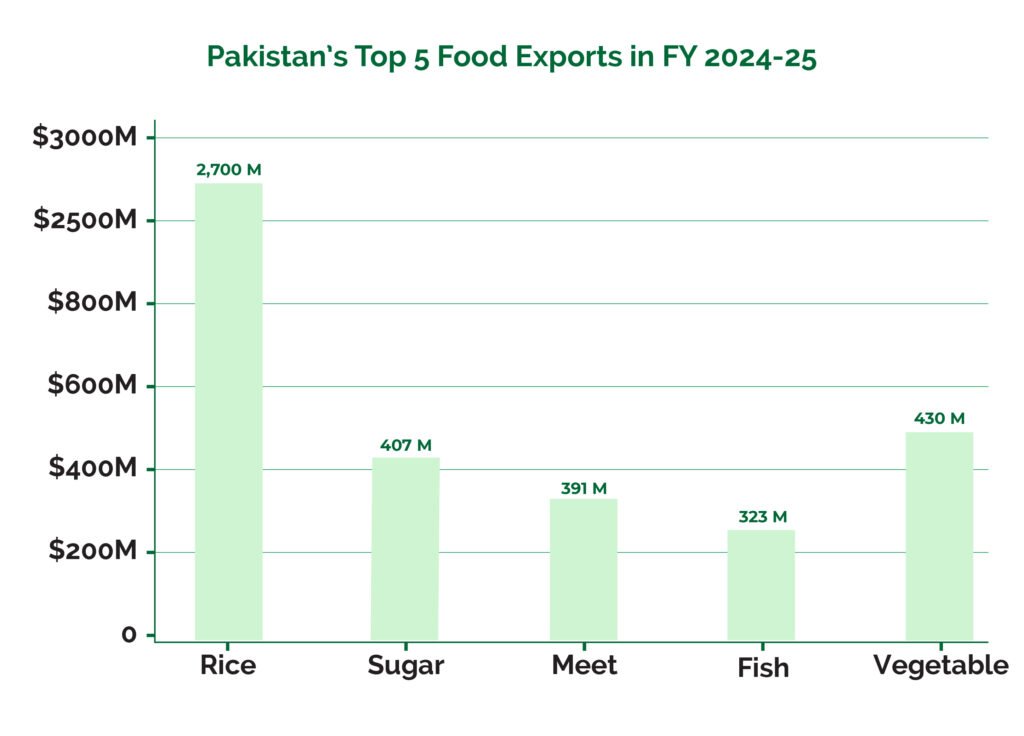
Food exports from Pakistan are gaining steady traction, marking a significant shift in the country’s agricultural and trade landscape. According to the Ministry of Commerce, Pakistan’s top five food exports in FY 2024–25 — rice, sugar, meat, fish, and vegetables — have collectively strengthened the nation’s position in global food trade. The performance of these sectors reflects not only production growth but also diversification in export destinations and improved competitiveness across markets in Asia and beyond.
Rice Leads with $2.7 Billion in Exports
Rice remains Pakistan’s leading food export, recording an impressive $2.7 billion in export value during FY 2024–25, according to the Ministry of Commerce. The country continues to be among the world’s largest rice exporters, with consistent demand from key Asian economies. According to the Global Agricultural Information Network, major importers included Indonesia, the Philippines, and Malaysia — reflecting strong intra-Asian trade ties.
This sustained growth underscores the competitiveness of Pakistan’s rice varieties, particularly basmati and non-basmati types, which continue to attract premium markets. The upward trajectory of rice exports also demonstrates Pakistan’s ability to maintain quality and supply chain stability despite climatic and logistical challenges.
Sugar Export Growth Driven by Demand in Afghanistan
Sugar ranked second among Pakistan’s food exports, contributing $407 million in FY 2024–25, according to the Ministry of Commerce. This surge was largely driven by a dramatic 4,332% increase in shipments to Afghanistan between July 2024 and January 2025, as reported by CropGpt. The reopening of trade routes, coupled with regional demand for refined sugar, positioned Pakistan as a key supplier in South and Central Asia.
Pakistan’s sugar sector benefits from both surplus domestic production and supportive export policies that allow millers to capitalize on regional market gaps. However, experts suggest that sustainable export performance will depend on balancing domestic supply and price stability alongside global trade opportunities.
Meat Exports Strengthened by China’s Demand
Pakistan’s meat exports generated $391 million in FY 2024–25, according to the Ministry of Commerce. China emerged as a leading buyer, with beef exports to the country increasing by 139%, according to China Economic Net. This expansion reflects the strengthening of Pakistan’s halal meat industry, which has seen new certifications, upgraded processing facilities, and compliance with international health standards.
Industry analysts note that the next step in expanding meat-related food exports lies in diversifying product offerings — particularly processed and value-added meats — to access premium markets in East Asia and the Middle East.
Seafood Sector Maintains Consistent Growth
Pakistan’s fish and seafood exports reached $323 million in FY 2024–25, according to the Ministry of Maritime Affairs. The Ministry of Maritime Affairs reports that China remained the largest buyer, importing 99,238 metric tons worth $186 million. Other key destinations included Thailand, the UAE, Malaysia, Japan, and South Korea, reflecting the sector’s strong regional footprint.
The expansion of aquaculture, improvements in cold-chain logistics, and compliance with sanitary standards have played a vital role in strengthening Pakistan’s seafood food exports. Policymakers continue to explore strategies for upgrading fisheries infrastructure to meet international demand for sustainable seafood.
Vegetable Exports Reflect Growing Regional Connectivity
Vegetable exports were valued at $430 million in FY 2024–25, according to the Ministry of Commerce. The Pakistan Bureau of Statistics identified Sri Lanka, the UAE, Afghanistan, and Malaysia as key markets, highlighting Pakistan’s ability to supply fresh produce across short-haul regional routes. Exporters continue to benefit from improved transport linkages and trade agreements that facilitate movement of perishable goods within South Asia and the Middle East.
Pakistan’s Expanding Role in Global Food Trade
Collectively, Pakistan’s food exports in FY 2024–25 reflect a growing role in global supply chains. From rice and sugar to meat and vegetables, the country is broadening its export base while enhancing product quality and compliance with global standards. This progress also reflects the government’s continued investment in trade facilitation, export diversification, and digital traceability systems.
To join our community visit now: Join Now